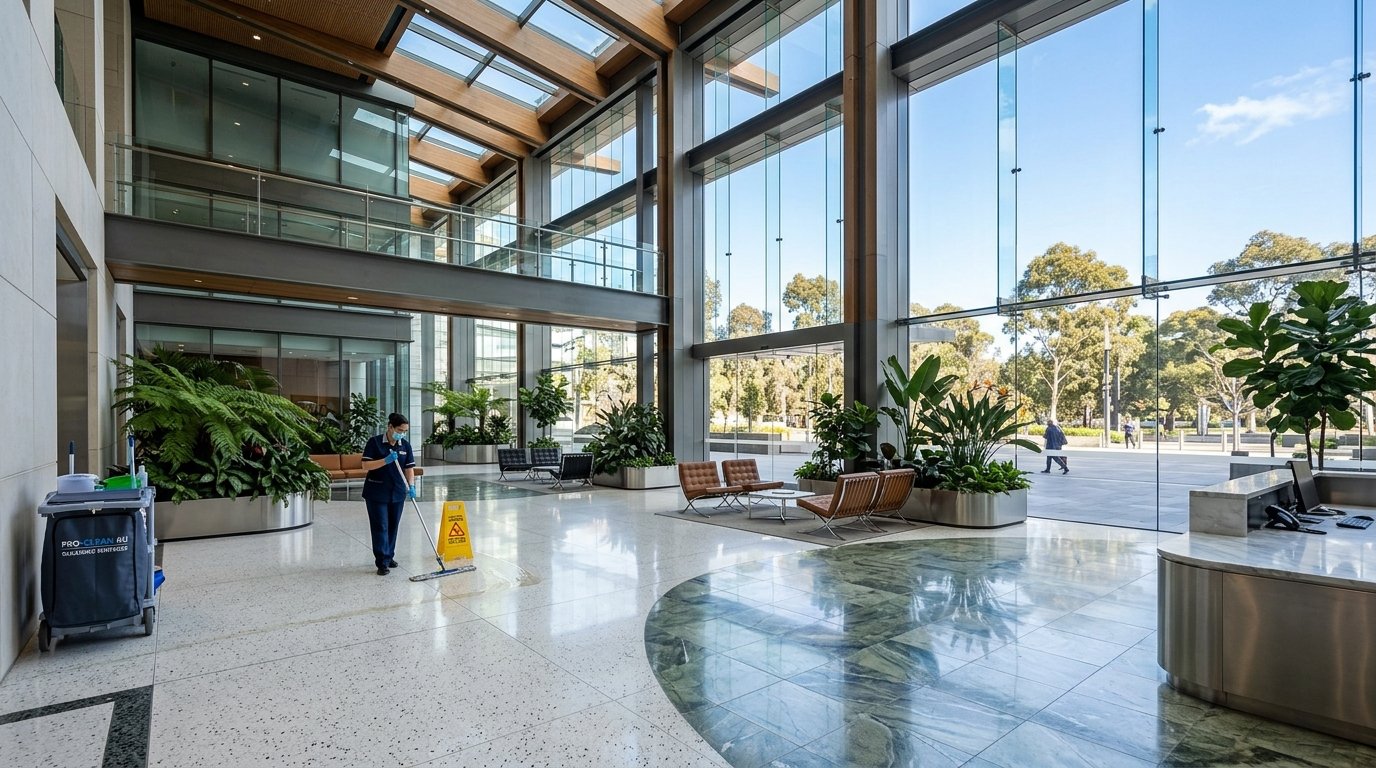
Executive Summary: Commercial vs In-House Cleaning
- Managing cleaners directly in-house saddles your business with severe administrative overhead: payroll tax, superannuation, leave liabilities, and WHS exposure.
- Commercial contractors deliver superior economies of scale: high-end mechanical machinery (\$10,000+ auto-scrubbers), wholesale chemical pricing, and guaranteed shift cover.
- When an in-house cleaner takes sick leave or annual leave, the facility goes uncleaned or operational managers are forced to clean toilets themselves.
- Outsourcing to a professional cleaning company yields an average 22% to 35% net operational savings while ensuring 100% service continuity.
1. The In-House Cleaning Illusion
Some business executives and facility controllers believe that employing their own cleaners directly on staff saves money by "eliminating contractor profit margins." On paper, paying someone \$16 an hour appears cheaper than hiring a commercial cleaning firm charging \$10 an hour.
However, this calculation ignores the vast iceberg of hidden direct and indirect costs associated with in-house cleaning. Commercial cleaning is a capital-intensive, labour-heavy, and highly regulated operational discipline. When companies examine true fully-loaded employment costs, equipment depreciation, chemical inventories, and management supervision time, the financial equation changes dramatically.
2. Comprehensive Financial Comparison: In-House vs Outsourced
| Operational Element | In-House Internal Cleaning Team | Professional Outsourced Contractor (Sparkle) |
|---|---|---|
| Direct Wage & On-Costs | Base award wage + 11.5% superannuation + workers' compensation insurance + 4 weeks annual leave + 10 days sick leave + long service leave provisions. | Fixed, predictable monthly invoice covering all employment wages, taxes, and statutory leave liabilities. |
| Equipment Capital Outlay | Business must purchase HEPA vacuums (\$100–\$1,500), auto-scrubbers (\$1,000–\$14,000), pressure washers, and cover ongoing repair/tagging bills. | Zero capital expenditure; contractor supplies modern industrial-grade machinery, replacement parts, and maintenance. |
| Absence & Leave Coverage | If staff are sick or on holiday, facility goes uncleaned, or administrative staff are pulled from primary duties to clean toilets. | Guaranteed 100% shift fulfillment; contractor provides trained relief personnel within 2 hours at no added cost. |
| WHS & Chemical Liability | Direct liability for chemical storage, SDS updates, eye-wash stations, slips/falls, and Fair Work Modern Award audits. | Contractor assumes statutory WHS responsibility, providing SWMS, compliant dilution units, and \$10M liability insurance. |
| Management Overhead | Office manager or FM spends 5 to 10 hours weekly rostering, interviewing replacements, purchasing paper, and handling grievances. | Zero supervisory burden; professional operations manager conducts monthly audits and handles staff management. |
| Consumable Procurement | Purchased at retail or small-commercial pricing with high delivery surcharges. | Procured at national wholesale volume discounts, passing savings directly to the client. |
3. The Operational Freedom of Outsourcing
Beyond direct financial savings, outsourcing commercial cleaning delivers vital operational agility. Your executive and administrative teams are free to concentrate on your company's core mission—whether that is legal practice, software development, healthcare delivery, or manufacturing—rather than managing cleaning rosters and unclogging vacuums.
Furthermore, an outsourced partner scales seamlessly with your business. If your company expands into an additional floor or relocates to larger premises, your cleaning contract simply expands overnight without needing to interview, vet, hire, and train new employees.