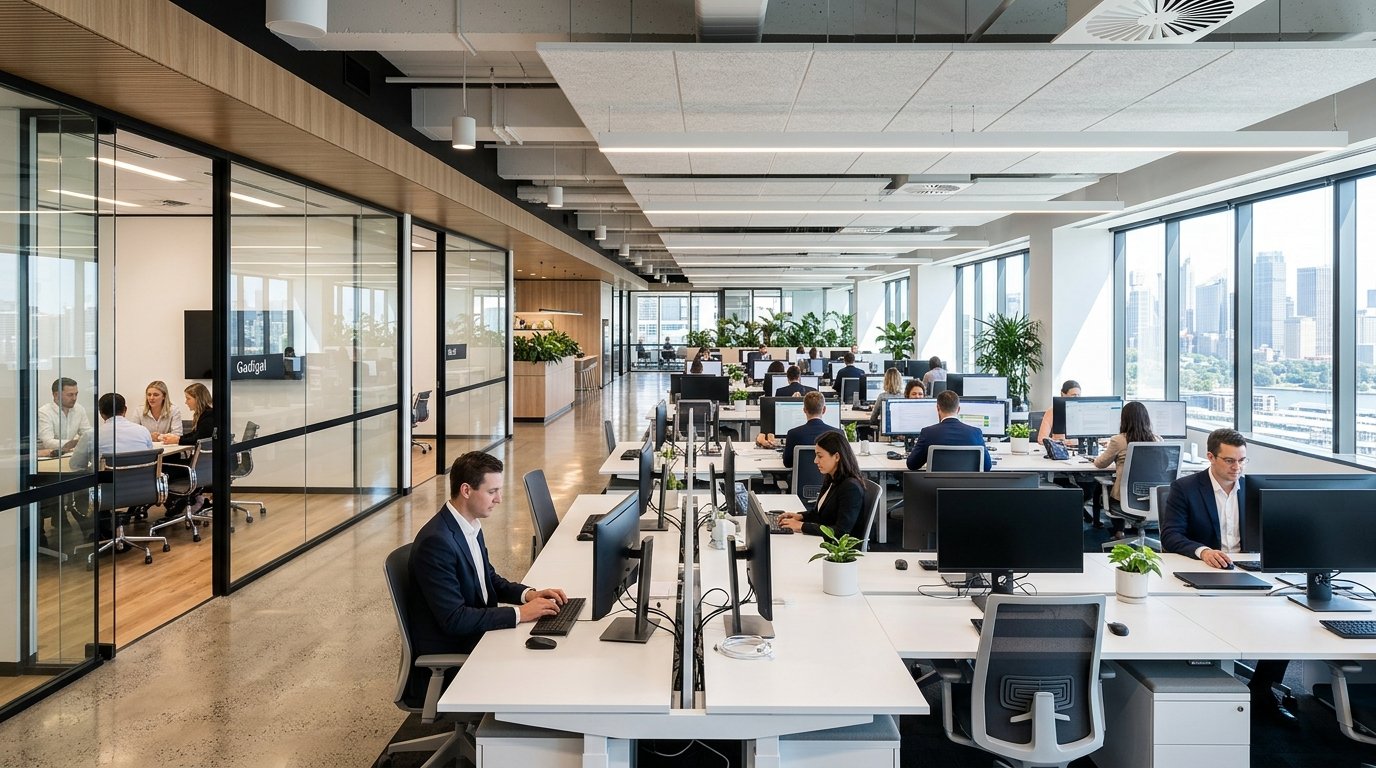
Executive Summary: What Is Commercial Cleaning?
- Commercial cleaning encompasses sanitisation, disinfection, floor maintenance, and waste management for commercial and institutional properties rather than private residences.
- It is governed by Australian WHS legislation (Work Health and Safety Act 2011), Safe Work Australia hazardous chemical guidelines, and the Fair Work Cleaning Services Award 2020.
- Professional commercial contractors deploy industrial machinery (auto-scrubbers, HEPA filtration vacuums, steam extractors) and hospital-grade TGA-approved disinfectants.
- Clean workplaces reduce employee absenteeism due to communicable disease transmission by up to 46% while significantly boosting brand reputation and client trust.
1. Defining Commercial Cleaning in the Australian Workplace
Commercial cleaning refers to specialised cleaning services delivered to non-residential environments—including corporate commercial offices, educational institutions, medical clinics, logistics hubs, retail stores, fitness centres, and industrial warehouses. Unlike domestic or residential housekeeping, commercial cleaning is governed by rigorous legislative frameworks, structured performance standards, and mandatory health and safety protocols.
In Australian commercial properties, facilities management teams rely on commercial cleaning contractors to maintain hygienic, compliant, and presentation-perfect spaces. Under the Work Health and Safety (WHS) Act 2011, Australian employers and building controllers have a non-delegable duty of care to ensure the workplace is safe, sanitary, and free of risks to worker health. Commercial cleaning is the frontline operational control mechanism that ensures this statutory duty is fulfilled.
"Under Safe Work Australia guidelines, workplace cleaning is not merely an aesthetic consideration—it is a critical risk mitigation measure that prevents cross-contamination, eliminates trip-and-slip hazards, and ensures compliance with Australian Standards such as AS 4586 for slip resistance."
2. Commercial Cleaning vs. Residential Cleaning: Core Differences
Many facility managers make the costly mistake of assuming commercial cleaning is simply residential cleaning on a larger scale. In reality, the equipment, chemistries, insurance liabilities, compliance frameworks, and shift structures differ radically:
| Operational Dimension | Commercial Cleaning | Residential / Domestic Cleaning |
|---|---|---|
| Facility Scale & Footprint | 100 m² to 50,000+ m² multi-storey office towers, logistics parks, campus facilities. | 50 m² to 350 m² private homes and apartments. |
| Equipment Used | Commercial walk-behind & ride-on auto-scrubbers, HEPA backpack extractors, high-speed rotary burnishers (1500 RPM), pure-water fed poles. | Domestic upright or cylinder vacuums, manual string mops, standard microfiber dusters. |
| Chemical Formulations | Hospital-grade TGA-registered disinfectants, enzymatic bio-cleaners, neutral floor maintainers with strict Safety Data Sheets (SDS). | Off-the-shelf domestic retail sprays, diluted bleach, standard detergents. |
| Operating Hours | After-hours (evening, night shift 6:00 PM – 2:00 AM) or early morning (4:00 AM – 7:30 AM) to prevent workplace disruption. | Standard daytime business hours (9:00 AM – 4:00 PM). |
| Legal & Insurance Shield | \$10M Public Liability Insurance, Workers' Compensation, Safe Work Method Statements (SWMS), Police Clearance Checks. | Basic domestic liability (\$1M–\$10M) or informal sole-trader arrangements. |
| Staffing & Award Compliance | Strictly governed by Fair Work Cleaning Services Award 2020 [MA000022] with full superannuation, penalty rates, and training records. | Informal hourly domestic rates or unregulated contractor arrangements. |
3. Key Types of Commercial Facilities
Commercial cleaning methods must be precision-tailored to the specific environmental and regulatory requirements of the sector:
- Corporate Office Buildings: Focuses on acoustic partition cleaning, touchpoint sanitisation (telephones, keyboards, elevator buttons), boardroom presentations, carpet hygiene, and high-spec washroom replenishment.
- Medical & Healthcare Clinics: Follows NHMRC Infection Prevention and Control Guidelines. Employs colour-coded microfibre systems, terminal room disinfection, bio-hazard waste removal, and non-porous floor sanitisation.
- Educational Campuses & Schools: Enforces Working With Children Checks (WWCC / Blue Cards), comprehensive desk and locker sanitisation, food hall degreasing, and term-break deep steam extractions.
- Warehouses & Logistics Hubs: Utilises heavy-duty mechanical floor scrubbers to remove forklift tire rubber, concrete dust, and oil grease, maintaining AS 4586 slip resistance compliance.
- Gyms & Fitness Centres: Targets antimicrobial equipment sanitisation, shower stall mould elimination, sauna hygiene, and persistent bio-odour neutralisation.
4. Essential Pillars of a Professional Commercial Cleaning Scope
When an organisation engages a commercial cleaning provider like Sparkle Cleaning Solutions, service delivery is structured across four primary service tiers:
- Routine Daily Maintenance: High-frequency tasks performed every working day—rubbish and recycling emptying, desk dusting, sanitising kitchen food preparation benches, washing down washroom fixtures, restocking consumables (toilet paper, hand towels, foaming soap), and vacuuming primary thoroughfares.
- Weekly Detail Work: Edge-to-edge vacuuming along skirting boards, cleaning glass entrance doors and conference room partitions, scrubbing kitchen splashbacks, descaling washroom urinals and grout lines, and spot-cleaning carpet spills.
- Monthly Deep Disinfection: High dusting of HVAC return diffusers and overhead light louvres (up to 3 metres), deep machine buffing of hard floors, and wiping down skirting boards and chair bases.
- Periodic Restorative Services: Scheduled quarterly, semi-annually, or annually—including hot water carpet steam extraction, vinyl strip and seal, external window abseiling or pure-water pole washing, and industrial scrubbing of loading bays.