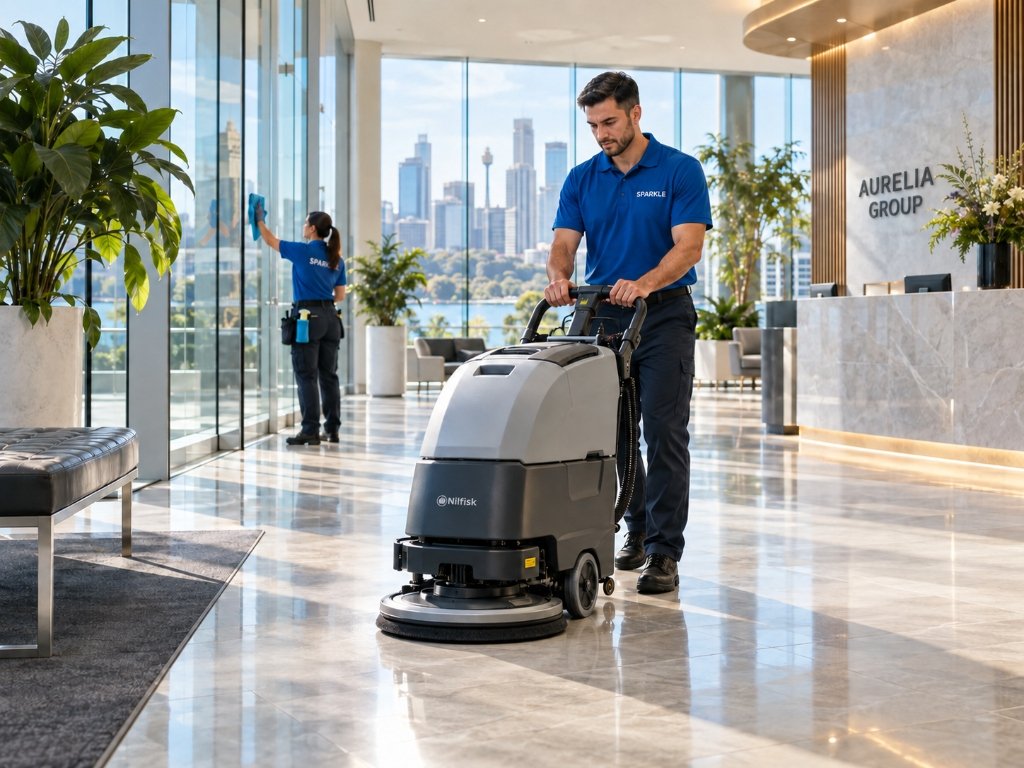
Executive Summary: Commercial Floor Care
- Flooring represents one of the largest capital investments in any commercial building, requiring structured daily, periodic, and restorative maintenance.
- Mechanical auto-scrubbers (walk-behind and ride-on) dramatically outperform manual mopping by lifting suspended particulate soil rather than spreading it.
- High-speed burnishing (1500–3000 RPM) creates a deep thermal gloss and hardens protective polymer sealers against heavy pedestrian wear.
- Proper floor cleaning ensures continuous compliance with Australian Slip Resistance Standard AS 4586, mitigating costly slip-and-fall liabilities.
1. The Science of Commercial Floor Maintenance
Commercial floors endure intense punishment: thousands of pedestrian footsteps grinding airborne grit, forklift tires tracking industrial oils, and wet weather depositing acidic moisture. Without professional mechanical maintenance, hard floor surfaces (vinyl, polished concrete, terrazzo, ceramic tile, and natural stone) quickly lose their protective coatings, develop micro-scratches, accumulate embedded dirt, and become dangerous slip hazards.
In Australia, slips, trips, and falls account for over 23% of all serious workplace compensation claims. Under AS 4586 (Slip resistance classification of pedestrian surface materials), facility managers are responsible for ensuring hard flooring maintains required slip friction ratings across both dry and wet conditions.
2. Modern Mechanical Floor Cleaning Technologies
Manual mop-and-bucket cleaning is completely ineffective for modern commercial footprints exceeding 200 m². Mops quickly saturate with dirty water, redepositing soil into grout lines and micropores. Sparkle Cleaning Solutions utilizes advanced mechanical technologies:
- Auto-Scrubber Driers: Walk-behind or ride-on machines that dispense precise chemical solution, scrub the floor with counter-rotating disc or cylindrical pads (180–300 RPM), and immediately vacuum the dirty slurry via a rear parabolic squeegee, leaving floors 100% dry and walk-ready in seconds.
- High-Speed Rotary Burnishers: Electric or battery machines running at 1500 to 2500 RPM fitted with thermal pads (such as natural hog hair or high-gloss synthetic fibres). The heat generated by friction smooths microscopic ridges in floor sealers, restoring a brilliant mirror gloss.
- Oscillating Diamond Grinding & Polishing: Specialized heavy machinery deploying resin-bonded diamond abrasives (from coarse 50-grit up to 3000-grit ultra-fine) to hone and polish concrete, terrazzo, and marble without chemical coatings.
3. Commercial Floor Care Method Comparison
| Process | Primary Machinery & Pad | Recommended Frequency | Intended Flooring Types |
|---|---|---|---|
| Daily Auto-Scrubbing | Compact walk-behind scrubber with red/white scrubbing pad or microfibre roller. | Daily to 3x weekly in high-traffic corridors and foyers. | Vinyl composite tile (VCT), polished concrete, epoxy warehouse floors, ceramic tile. |
| High-Speed Buffing & Burnishing | Ultra-high-speed (UHS) 1500–2000 RPM burnisher with natural hair or tan pad. | Weekly to fortnightly depending on pedestrian foot traffic. | Sealed vinyl, linoleum, finished terrazzo. |
| Deep Scrub & Recoat (Top Scrub) | Low-speed rotary (175 RPM) with green or blue intermediate scrubbing pad. | Every 3 to 6 months. | Worn sealed vinyl where top coat is scuffed but base sealer remains intact. |
| Complete Strip and Seal | Low-speed floor machine with black stripping pad and chemical stripper, wet vac extraction. | Annually or bi-annually. | Vinyl, linoleum, porous terrazzo requiring complete removal of aged, discoloured sealer. |
| Diamond Concrete Polishing | Planetary multi-head concrete grinder with resin diamond pads (400–3000 grit). | Every 2 to 4 years for restoration. | Bare and hardened commercial concrete, warehouse slabs, modern industrial retail. |
4. Best Practices for Preserving Commercial Hard Floors
- Deploy High-Performance Walk-Off Barrier Matting: Place 3 to 5 metres of commercial ribbed matting at every exterior entrance. This captures up to 85% of pedestrian soil and grit before it ever touches your floors.
- Maintain Neutral pH Solutions: Avoid aggressive high-alkaline degreasers on sealed floors, which strip gloss and leave dull chemical haze. Use certified neutral floor maintainers (pH 7.0–7.5).
- Never Dry-Sweep Grit: Dry sweeping pushes micro-abrasives across the floor like sandpaper. Always dry-dust mop with an electrostatic fringe mop, followed by auto-scrubbing.